The Green Paradox

Could Carbon Dioxide Help Turn the Sahara Green Again?
eyesonsaudi-arabia
For decades, carbon dioxide has been cast as the villain of the climate story.
It is the gas most associated with global warming, rising temperatures, melting glaciers, and extreme weather. Policymakers seek to reduce it, industries are taxed for emitting it, and entire energy strategies are built around lowering atmospheric CO₂ concentrations.
Yet inside the glass walls of Türkiye’s Sultan Sera greenhouse in Aydın, carbon dioxide plays a very different role.
There, CO₂ extracted from geothermal spring water is deliberately released into the greenhouse atmosphere because it makes plants grow faster and more efficiently. Tomatoes thrive in this enriched environment. Higher CO₂ concentrations increase photosynthesis, allowing plants to convert sunlight, water, and nutrients into biomass more effectively. The greenhouse is a striking reminder that carbon dioxide is not merely a waste product. It is also plant food.
This raises a fascinating question:
If CO₂ accelerates plant growth inside a greenhouse, could rising atmospheric CO₂ help make some of the world’s deserts greener?
The surprising answer is: in certain circumstances, yes.
The Planet Is Getting Greener
Satellite observations have revealed a remarkable trend over recent decades. According to research highlighted by NASA, between one-quarter and one-half of the Earth’s vegetated lands have shown significant greening since the early 1980s, with rising atmospheric CO₂ identified as a major contributing factor. Studies cited by NASA found that CO₂ fertilization accounted for about 70% of the observed greening signal. [nasa.gov]
The mechanism is straightforward.
As atmospheric CO₂ increases, many plants can photosynthesize more efficiently. In dry environments, plants may also lose less water because they do not need to keep their leaf pores open as long to absorb the carbon dioxide they need. This can improve water-use efficiency and help vegetation survive under more arid conditions. [nasa.gov], [nature.com]
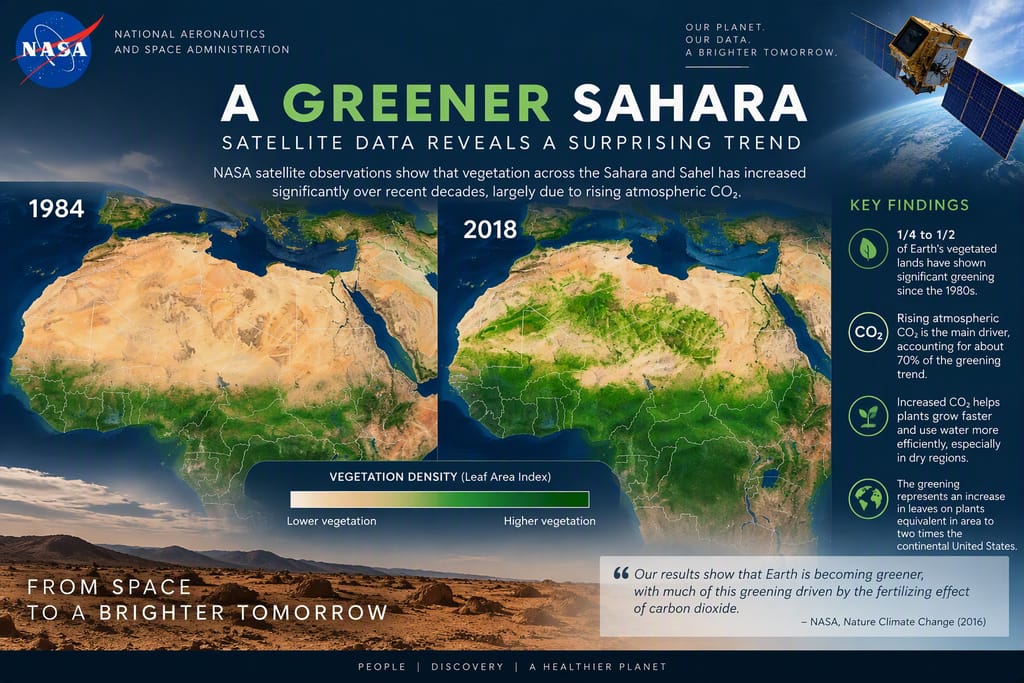
Scientists have even identified evidence and model projections linking elevated CO₂ to increased vegetation across parts of dryland regions and the Sahel, the semi-arid zone south of the Sahara. [journals.ametsoc.org], [nature.com]
The Sahara’s Forgotten Green Past
The idea of a green Sahara may sound like science fiction, but it is actually history.
Thousands of years ago, during what scientists call the African Humid Period, large areas of today’s Sahara were covered by grasslands, lakes, and vegetation. Evidence from paleoclimate research shows that North Africa once supported a much wetter landscape than exists today. [cell.com], [climamed.eu]
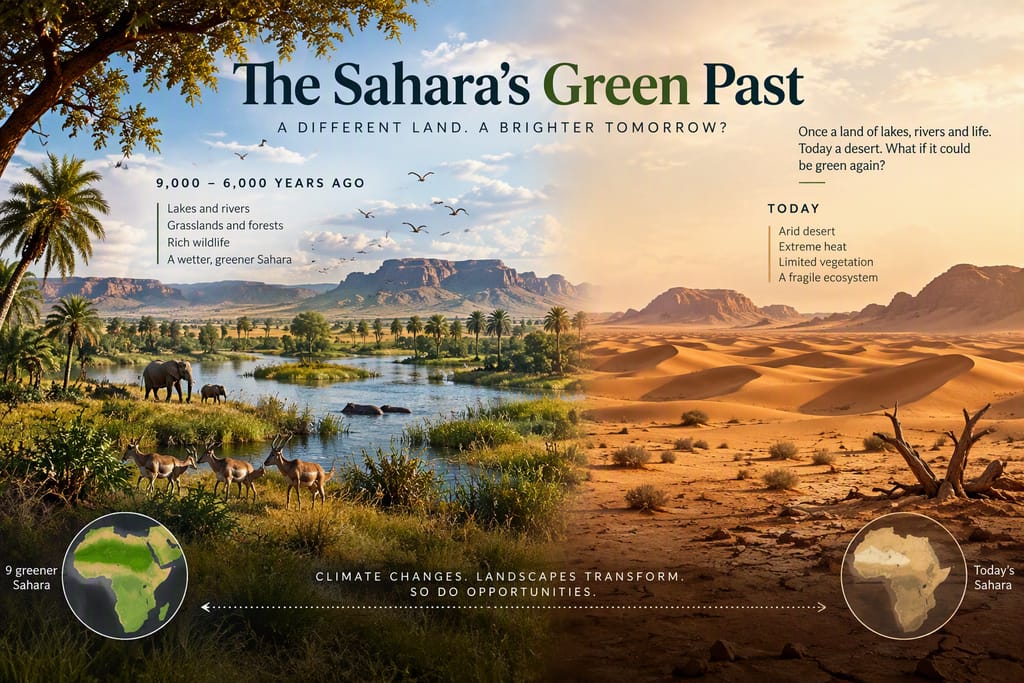
Researchers studying climate-vegetation interactions have found that vegetation itself can reinforce wetter regional climates. More plants can increase moisture recycling, influence temperatures, and support rainfall patterns that help sustain additional vegetation. [climamed.eu], [cell.com]
Some climate studies even suggest that parts of the Sahara and Sahel could experience increased rainfall in the future under certain climate scenarios. [cell.com]
This does not mean the entire Sahara will suddenly transform into a forest. Water availability remains the decisive factor. But it does suggest that desert ecosystems may be more dynamic than commonly assumed.
The Great Climate Paradox
This is where the story becomes truly intriguing.
The same gas contributing to global warming is also helping vegetation grow.
Both statements can be true simultaneously.
Carbon dioxide traps heat in the atmosphere, contributing to climate change. At the same time, carbon dioxide is an essential ingredient of photosynthesis and can stimulate plant growth under suitable conditions. [nasa.gov], [nature.com]
In other words, nature does not recognize political slogans.
CO₂ is neither hero nor villain. It is a molecule with multiple effects, some beneficial and some harmful, depending on context.
Inside Sultan Sera, greenhouse operators deliberately enrich the air with CO₂ because the benefits are immediate and measurable. On a planetary scale, the picture becomes more complex because increased plant growth occurs alongside rising temperatures, changing rainfall patterns, and other climatic impacts.
The paradox is real: the same molecule causing concern in climate policy is also contributing to measurable greening across parts of the Earth. [nasa.gov]
A Saudi Opportunity
Few countries may be better positioned to explore this paradox than Saudi Arabia.
The Kingdom possesses three assets rarely found together:
- Vast desert landscapes
- Significant energy resources
- Ambitious environmental transformation programs
Saudi initiatives aimed at large-scale land restoration and afforestation already seek to expand vegetation cover in arid regions. If future research confirms that combinations of irrigation, drought-resistant plants, advanced greenhouse technologies, and carefully managed CO₂ enrichment can accelerate desert greening, Saudi Arabia could become a global laboratory for climate-adaptive agriculture.
The lesson from Sultan Sera is instructive.
Rather than viewing carbon dioxide solely as a problem to eliminate, innovative projects may increasingly treat it as a resource to manage intelligently. In controlled environments, CO₂ can boost food production. In drylands, it may enhance vegetation growth when water is available. Combined with desalination, renewable energy, precision irrigation, and environmental restoration, it could become part of a broader strategy for productive desert landscapes.
From Greenhouse to Green Desert
The geothermal greenhouse in western Türkiye offers a glimpse of a larger possibility.
There, carbon dioxide captured from geothermal water is used to nourish crops. The result is a highly productive ecosystem operating in a carefully managed environment. The principle is simple: plants need CO₂.
The emerging question for the 21st century is whether lessons from such systems can be applied on a much larger scale.
If deserts can be supplied with sufficient water, if suitable plant species are selected, and if technological innovation continues to advance, regions currently considered barren may one day become substantially greener.
The irony would be remarkable.
The gas that became the symbol of humanity’s climate challenge could also become one of the tools helping humanity restore some of the planet’s most inhospitable landscapes. That does not erase the risks of climate change. But it does remind us that nature is often more nuanced, and more surprising, than our narratives allow.